Olympic Stadium and Sporting Fields (8)
Location: Olympischer Platz
Today: Still there.
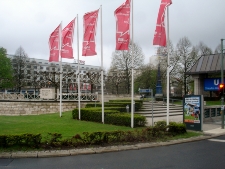
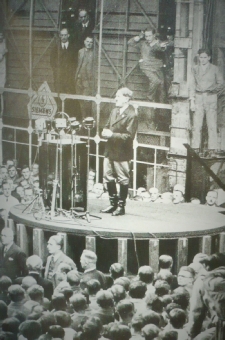
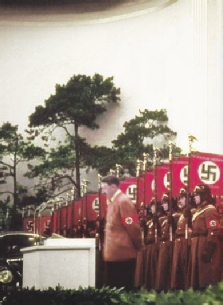
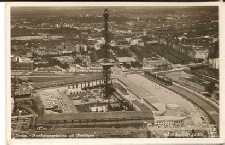
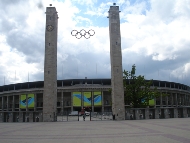
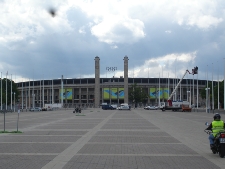
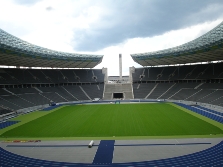
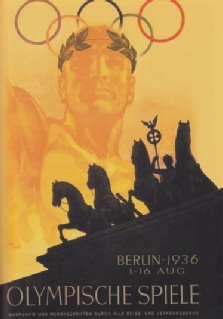
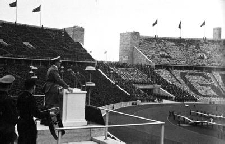
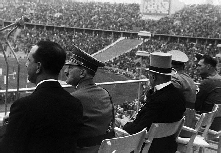
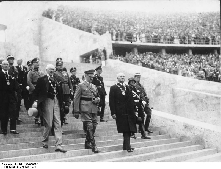
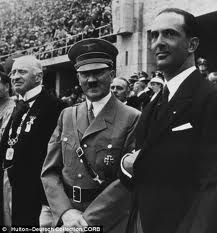
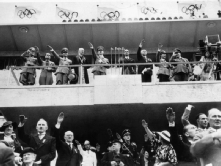
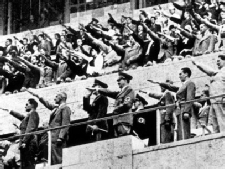
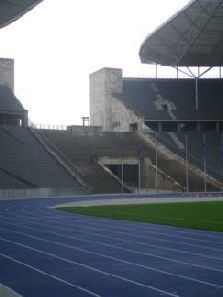
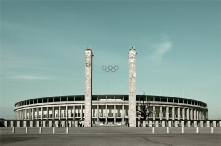
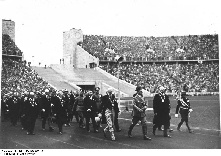
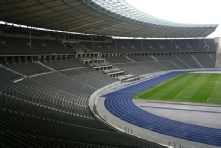
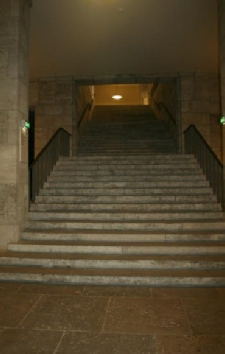
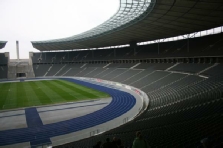
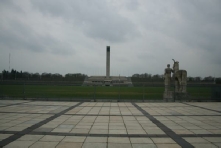
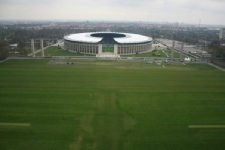
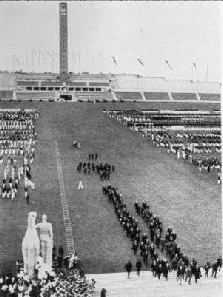
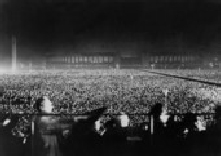
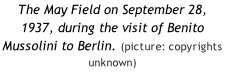
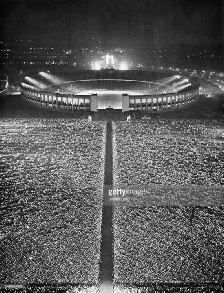
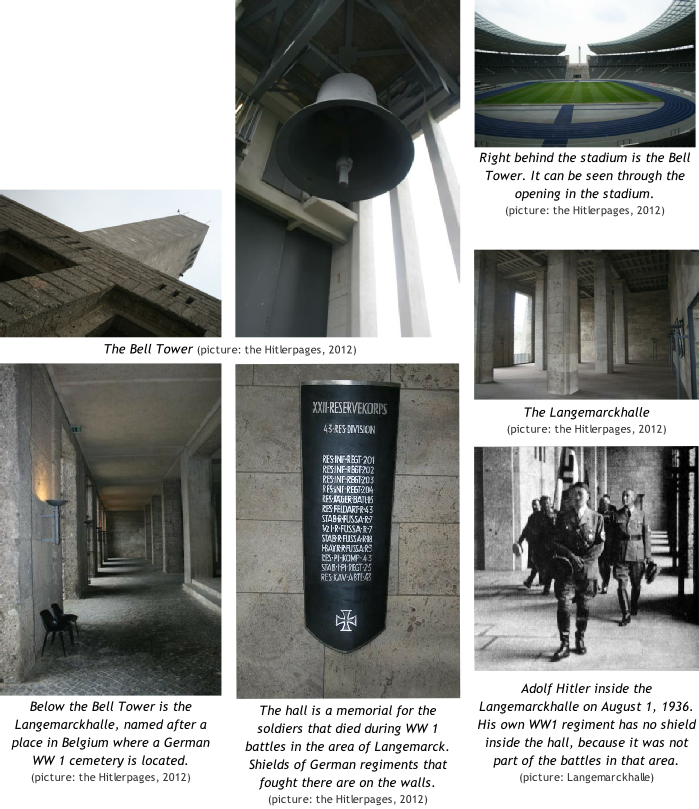
The stadium was built by Werner March for the Olympic Games in 1936 . The train station nearby was built in the same period. On August 1, 1936 Hitler held a speech at the opening of the Olympic Games in this stadium. On May 1, 1937 Hitler spoke to 120.000 members of the Hitlerjugend. On the same date, only a year later he spoke here again, also for the Hitlerjugend. The last yearly speech on May 1 for the Hitlerjugend took place in 1939. There were 100.000 young people present.
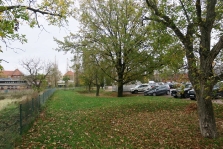
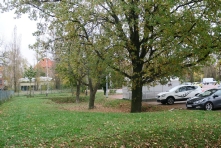
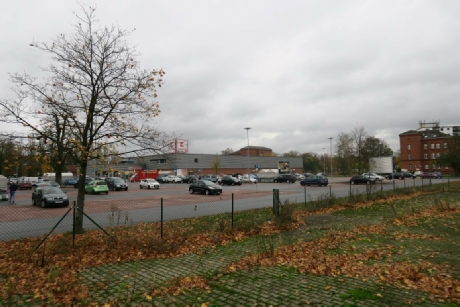
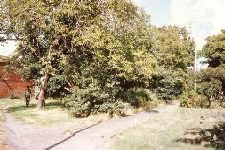
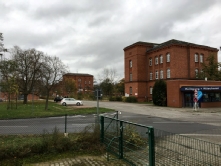
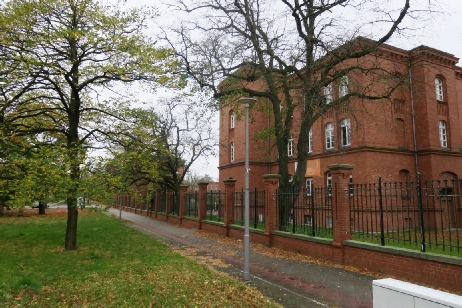
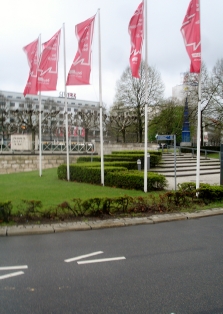
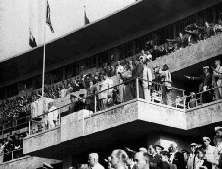
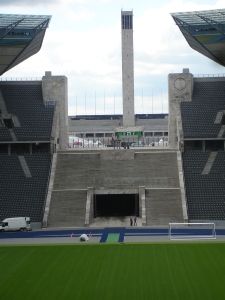
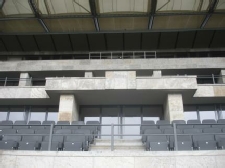
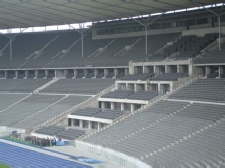
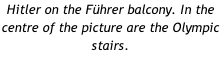
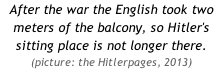
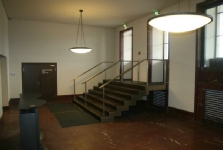
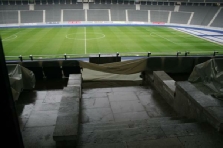
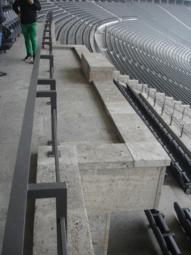
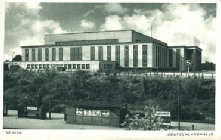
Above and below: The Olympic Stadium from the inside and the outside. The picture on the right shows the place were the Führerbalcony was.
(pictures: the Hitlerpages,  2006)
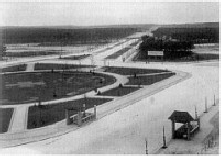
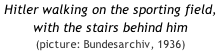
The Olympic Stadium in 1936
Hitler speaks to the Hitlerjugend on May 1, 1938.
(picture: Hitlerjugend, 2003)
Villa Wansee Conference (1)
Location: Am Grossen Wannsee 56 - 58
Today: documentation centre
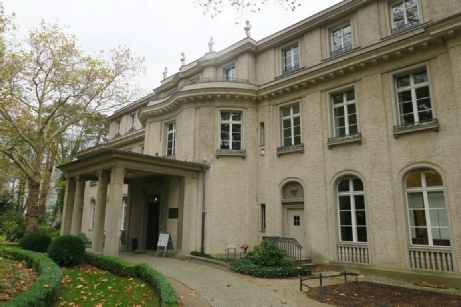
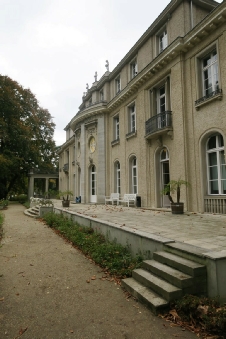
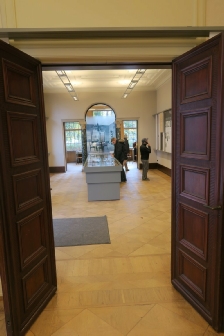
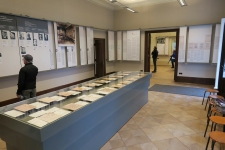
The villa has become a documentation centre about the Wannsee Conference and the Holocaust. The translated minutes of the Wannsee Conference are on the internet, by the way. Look at this website for more information.
The Wannsee villa.

Internationale Automobil Ausstellung (13)

Location: Messegelände, Kaiserdamm Masurenallee; the (second) Automobil-Ausstellungshalle of 1924 was located at the grounds of what today is the Omnibusbahnhof

Today: Omnibusbahnhof-area

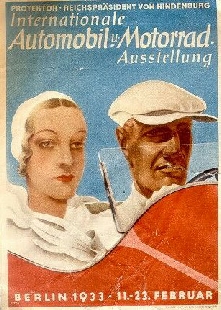
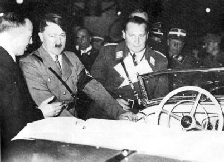
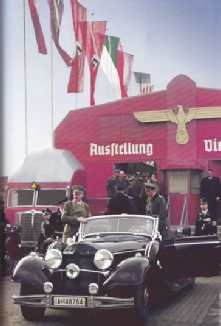
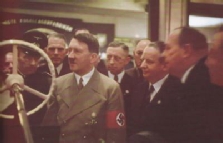
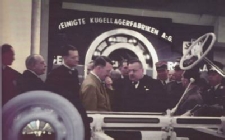
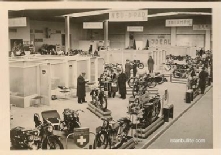
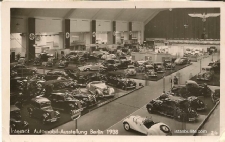
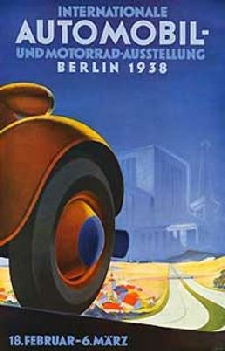
On February 11, 1933 and on March 7, 1934 Hitler opened the Internationale Automobilausstellung in Berlin. The exact location was not mentioned in the source I used. On February 14, 1935 he opened this exhibition again. This time the location is mentioned: the Ausstellungshallen. On February 15, 1936 Hitler opened the international car exhibition again with a speech and on February 27, 1936 he spoke to car manufacturers during the exhibition. On February 20, 1937 Hitler opened the Automobilausstellung of 1937 and the next year on February 18 he did the same. February 17, 1939 was the last time Hitler opened the International Carexhibition in the Messehallen.


Automobilausstellung 1933.
Hitler and Göring at the Automobilausstellung 0f 1934.
(picture: Hitlers Handlangers, 2004)
Hitler held an opening speech at the Automobilausstellung of 1939
(on February 17).
(picture: Reichshauptstadt Berlin, 2009)
Hitler at the Automobilausstellung of 1939, on February 17.
(picture: Reichshauptstadt Berlin, 2009)
Gaststätte Neue Welt (11)
Location: There seems to be a Gaststätte Neue Welt at Reichsstrasse 3
Today: Not sure about the origin of the location or building.
Hitler held a speech at the Neue Welt on December 4, 1930.
Theodor Heuss Platz (12)
Location: The Theodor Heuss Platz is a square near the Olympic Stadium
Today: The square is still there, but Hitlers plans with it were never realised.
The Theodor Heuss Platz has had a number of different names. Before 1933 it was called the Reichskanzler Platz. After 1933 it was renamed as Adolf Hitler Platz. Adolf Hitler drew a monument for Mussolini, that was to be placed on the square. After that the name of it would change into the Mussolini Square. Because of the war, the monument was never built.
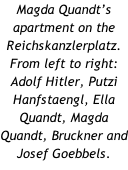
Left: Reichskanzlerplatz, 1907;  Centre and right: Theodor Heuss Platz today
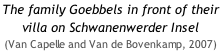
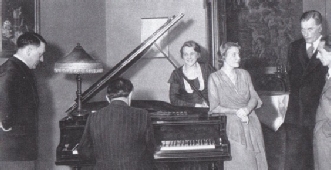
Hitler (on the left) in one of the house of the family  Goebbels, which one this is, is not sure.
Villa of Ribbentrop (30)
Location: Lentzenallee 7-9, district of Dahlem
Today: Unknown, probably gone.
In the night between January 10 and 11 1933 Hitler negotiated with Papen in the villa of Ribbentrop.

Kameradadschaft der Deutschen Künstler (28 or 29)

Location: Victoriastrasse 4

Today: unknow

It is said that Hitler used to come here.

Fehrbelliner Platz
Location: Hohenzollerndamm/Brandenburgische Straße
Today: Government offices.
The Fehrbellinerplatz was the centre of nazi-administration. There are some good exemples of nazi-architecture there.
This building was originally used by the Nordstern-Versicherung. It wasbuild between 1934 and 1936.
(picture: wikipedia, Doris Antony, 2008)
Grossbelastungskörper/ heavy load testing body (21)
Location: Near Tempelhof Airport, corner General Pape Strasse/Löwenhardtdamm
Today: Still there
To test if the grounds in Berlin could carry the weight of a large Triumphal Arch, Albert Speer placed a heavy load concrete testing body here. They found out the ground could support it. The plans to rebuilt Berlin were never realised.

Speers Schwerbealstungskörper was ment to test if the Berlin grounds  

for the large buildings planned.

(picture: Reichshauptstadt Berlin, 2009)

Headquarters Leibstandarte Adolf Hitler/ Lichterfelde Cadet School (31)
Location: Finkkensteinallee 63
Today: Federal Archives of Germany, two stone SS-soldiers at the entrance are covered up by concrete.
This military complex was not built by the nazi’s. In 1933 the SS took over the building.
Several SA leaders were shot here in 1934, when Röhm and his men were killed.
Left: Hitler at Lichterfelde in November 1933
Right: Lichterfelde today
Sowjet Ehrenmal (27)
Location: Treptow  Park
Today: still there
The marble on this large memorial for the Russian soldiers was taken from the New Reichskanzlei of Adolf Hitler.
Left and centre: The Sovjet Monument in Treptow.
(pictures: the Hitlerpages,  2006)
The red marble on the monument was taken from the New Reichskanzlei (right)

Technischen Hochschule, Wehrtechnische Fakultät (5-7)

Location: Straße des 17. Juni, remains of the planned Wehrtechnische Fakultät are behind the Telefunken-Hochhaus (Ernst-Reuter-Platz 7) on the Bismarckstraße (and underneath the Teufelsberg)

Today: The Hochschule is called Technische Universität Berlin today. Parts of the old building are still visible. The Wehrtechnische Fakultät was never finished.

On November 27, 1937 Hitler held a speech when the first stone was layed of the Wertechnischen Fakultät of the Technischen Hochschule. The Ehrentribune from which Hitler watched his birthdayparade on April 20, 1939 stood in front of the Technischen Hochschule.


The building of the Technischen Hochschule in 1895

(picture: public domain, www.wikipedia.de)

The Technischen Universität in 2006. On the right you can see a wall of the old building.

(picture: www.wikipedia.de)


Geburtstagparade 1939. Hitler watches the parade pass the  Technischen Hochschule.

(picture: Reichshauptstadt Berlin, 2009)


Hitler watching the parade pass the  Technischen Hochschule.

(picture: Hitler, de aanslagen, 2006)


Speech for students (5-7)

Location: unknown

On February 4, 1933 Hitler spoke to students in Berlin on an unknown location.


A meeting at the university in 1934. If Hitler was present or on what exact date this picture was taken, we don’t know.

(picture: Bundesarchiv, www.wikipedia.de)  

Hotel Rheingold (2)
Location: Not sure if it’s the right hotel, but there is a hotel Rheingold at Xantener Srasse 9 (near the Kurfürstendamm)
Today: Not sure.
Adolf Hitler held a speech at the hotel Rheingold on October 13, 1930.

Haus des Deutschen Fremdesverkehrs (Runde Platz) (16)

Location: Potsdammer Straße, right across the road from the Sigismundstraße (on the side of the Kulturforum Berlin and a small park)

Today: Not longer there. The Kulturforum Berlin is ther e now. The building was ruïned in the war. The ruïnes were taken away in the 50’s.

The house of German tourism was part of the plans for the new Germania Hitler was going to built. In fact it was one of the few parts of Germania that was almost finished.On June 14, 1938 Hitler layed the first stone of the German House of Tourisme on the Runde Platz. More information about Germania can be found here: kunst.gymszbad.de.


Hitler lays the first stone of the Haus des Deutschen Fremdenverkehrs.

(picture: Bundesarchiv, www.wikipedia.de)

The building in 1959

(picture: einestages.spiegel.de)

Hitler walking towards the Haus des Deutschen Fremdesverkehrs on the Potsdammerstraße for the opening ceremony in 1938.

(picture: Reichshauotstadt Berlin, 2009)

Görlitzer Bahnhof (26)

Location: Berlin south-east, between Wiener Strasse and the Görlizter Strasse

Today: Gone. There’s a park (the Görlizer Park) and a swimming pool now. The Spreewaldplatz used to be the Bahnhofsvorplatz. The U-bahnhof in the area is still called Görlitzer Bahnhof.

This station was the beginning of the track through Cottbus to Görlizt. Hitler used this Bahnhof for instance for his trip to Czechoslovakia. A picture below shows him returning from there.

Hitler arriving at the Görlitzer Bahnhof, after a trip to Czechoslovakia.

A map of the area of the station. There’s a park at this location today.

(map: wikipedia, public domain)

The station in 1928.

(picture: wikipedia, public domain)

Berlin South

Berlin South  here is the area south  of the Bismarckstrasse, the Strasse des 17. Juni and south of it and south of the Karl-Marx-Allee/Frankfurter Allee.    

1.Bar Alois Hitler 2. Hotel Rheingold 3. Wilmersdorfer Tennishallen 4. Fehrbelliner Platz 5. Wehrtechnische Fakultät 6. Ernst Reuter Platz 7. Technischen Hochschule 8. Opel dealer were William Patrick Hitler worked 9. Flakturm 10. Zoölogischer Garten 11. Kaiser-Wilhelm-Gedächtniskirche 12. Bar Alois Hitler 13. Siegessäule 14. Albert Speers Streetlights 15. Bendlerblock 16. Haus des Deutschen Fremdesverkehrs 17. Hotel Sanssouci 18. Hotel Excelsior 19. Anhalter Bahnhof 20. Sportpalast 21. Grossbelastungskörper 22. Arc de Triomphe 23. South Station 24. Tempelhof 25. Reichsbank 26. Görlitzer Bahnhof 27. Treptower Park 28. or 29. Kameradschaft der Deutschen Künstler (?) 30. Villa Ribbentrop 31. Leibstandarte Adolf Hitler   

32. Practice Theo Morell 1919 -1935

33. Practice Theo Morell 1935 - 1945


Berlin South weergeven op een grotere kaart
Wineshop/bar of Alois Hitler (1)
Location: Leonhardstrasse 5, about 100 m. from station Charlottenburg
Today: Not sure.
Alois Hitler, the half brother of Adolf Hitler, had a wineshop/bar at the Leonhardstrasse.
Restaurant ‘Alois’ (12)
Location: Wittenbergplatz 3
Today: There’s an Italian restaurant on this address now, called Mola.
Adolf Hitlers half brother Alois had a restaurant here.
The Wittenbergplatz today.
The former restaurant of Alois Hitler is called Mola today.
Reichsbank (25)
Location: Werderstrasse, Werderscher Markt 1
Today: Foreign ministry.
The architect of this building was chosen by Hitler. The building was ready in 1940. After the war it became the headquarters for the Communist Party.
Left: The Reichsbank today. Centre and right: The laying of the first stone of the Reichsbank. Schacht shows Hitler the building grounds. May 5, 1934. (picture on the right: Reichshauptstadt Berlin, 2009)
Anhalter Railway Station (19)
Location: Askanischer Platz 6-7
Today: Only the facade and some minor parts remain.
The (once) largest station in Europe was bombed in 1945.
Anhalter Bahnhof in 1902.
(picture: Berlin, Damals und Heute, 2009)
The remains of the railway
station today.
Siegessäule (Victory Column) (13)
Location: Grosser Stern (square)
Today: Still there.
The Siegessäule stood on the Königsplatz in front of the Reichstag. Albert Speer had it removed to the Grosser Stern because of the big plans Hitler and Speer had with the city. The column itself was not built by the nazi’s; it was in Berlin long before they came to power.

From left to right: The Siegessäule on the Königsplatz in 1930 (Berlin, Damals und Heute, 2009),  the pillar under construction (picture: Reichshauptstadt Berlin, 2009) and the Siegessäule today. Albert Speer added an extra part to the pillar, as you can see on the picture on the right. (picture: The Hitlerpages, 2006)

Zoo Flak Tower (9-10)
Location: In the southeast area of the Zoologischer Garten, near the canal
Today: The Zoo Flaktower was destroyed.
Hitler had air-raid shelters built all over Germany. Hitler gave instructions to built six towers in Berlin. Three of them were realised before the end of the war.
The Zoo Flakturm, as it was.

Tennishallen (Wilmersdorfer Tennishallen) (3)

Location: Brandenburgische Strasse corner Konstanzer Strasse

Today: A depot of the Berliner Hafen- und Lagerhaus Betriebe (BEHALA) is there now.

The Tennishallen were built in 3 months in 1930. The hall  served as a depot for ammunition in the war. On January 27, and February 10, 1932 Hitler spoke at the tennishall .

The Wilmersdorfer Tennishallen at the end of the war.

Opel Eduard Winter and other locations were William Patrick Hitler worked (8)
Location: Kurfürstendam 207
Today: Not sure.
William Patrick Hitler worked in Berlin for a while, for the following companies:
1. Reichskrecht Gesellschaft
2. Opel, Rüsselheim
3. Opel Eduard Winter,
4. Schultheiss-brewery, Landsberger Allee 24
Kaiser-Wilhelm-Gedächniskirche (11)
Location: Breitscheidplatz
Today: War memorial.
The ruïns of this church are a reminder of WW II. There’s a modern tower/chappel right next to it.

The Gedächniskirche in 1930.

(picture: Berlin, Damals und Heute, 2009)

The Gedächniskirche is a reminder of the destructive power of war.

(pictures: The Hitlerpages)

Albert Speer’s Streetlights (14)
Location: Along the Strasse des 17 Juni
Today: A lot of the streetlights are still there.
Germania was never realised and the new Reichskanzlei was ruïned after the war, but Albert Speer left Berlin the streetlights along the Strasse des 17. Juni.

The streetlights designed by Albert Speer. (picture: The Hitlerpages, 2004)

Bendlerblock/Reichswehrministerium (15)

Location: Stauffenbergstraße (originally named Bendlerstrasse), south of the Tiergarten

Today: Still there.

The Bendlerblock was erected between 1911 and 1914 and used by the Reich Navy Office. During the Weimar Republic the building served as the seat of the Reichswehr Command. The building serves as secondary office of the German Federal Ministry of Defence. It also is a major memorial for the plot against Hitlers life on July 20, 1944. In the courtyard of the building the conspirators (including Graf von Stauffenberg) were executed. On March 13, 1937 Hitler held a speech for Generalfeldmaschall von Blomberg, who served the army 40 years.

The Bendlerblock and its courtyard were Stauffenberg was executed.  (pictures: The Hitlerpages, 2009)

House of General Hammerstein-Equord (15)

Location: Ostflügel of the Bendlerblock, Stauffenbergstraße (originally named Bendlerstrasse), south of the Tiergarten

Today: The Bendlerblock is still there.  

On February 3, 1933 Hitler spoke for the army leaders at the house of general Hammerstein-Equord.

Speech to Reichswehrgenerälen (15)

Location: unknown

During a meeting of the army command and the leaders of the SA on February 28, 1934 Hitler made very clear that the Reichswehr would be the only army of Germany. The SA was going to be an institute for ideological education. Röhm, the leader of the SA was very angry and he expressed his criticism on Hitler. The SA secretly continued to arm itself.


Hotel Sanssouci (17)
Location: Linkstrasse 37 (South of Potsdamer Platz)
Today: Modern buildings.
On October 14, 1930 Hitler held a speech at the hotel Sanssouci. Earlier that year (on May 21-22) Hitler had a fight with Otto Strasser at this hotel. Strasser belonged to the ‘Sozialrevolutionären Flügel’ (social revolutionairy wing) of the NSDAP that stood opposite to Hitlers NSDAP from South-Germanys. Strasser wanted the NSDAP to become more of an anti-kapitalistic movement. On July 4, 1930 Strasser left the NSDAP (or was kicked out by Goebbels...).
Hitler must have stayed at this hotel on a few other occasions too. It is said that when William Patrick Hitler talked to the English press about Adolf Hitler and family-bussinness, he was invited to Berlin. In presence of his father, Alois, and his ant Hitler met him in a hotel in the Linkstrasse to strongly advise him not to talk to the press again.  
A drawing of hotel Sanssouci
(source: www.hauptstadtberlin.org)
Hotel Excelsior (18)
Location: Askanischer Platz, across the street from the Anhalter Bahnhof
Today: gone
The Hotel Excelsior was one of the biggest and most modern hotels in the world. Here the Nazi Party wanted to go on the eve of their assumption of power. The owner of the hotel must have turned down the honour. The hotel Kaiserhof was their second choice for that event.

Right: The hotel Excelsior (brochure: David Levine Collection)

Left: The Anhalter Bahnjof Site, with the Europahaus and the Excelsiorhaus (2005).

Germania, Triumphal Arch and South Station (22-23)

Location: Arch: Bridge between the Dudenstrasse and the Kolonnenstraße. Station: At the end of the road, somewhere in the area of the General-Pape-Strasse.

Today: Never realised

Adolf Hitler and Albert Speer had great plans with Berlin. An impressive road with large buildings had to run from the Platz der Republik to the General-Pape-Strasse. On the Platz der Republik a very large building, the Great Hall, was to be built. At the location where a bridge between the Dudenstrasse and the Kolonnenstraße is today an Arc de Triomphe was to be built. At the end of the road, somewhere in the area of the General-Pape-Strasse, a large station (South Station) had to arise. Although building had begun, for instance in the Reichstag-area, and families were already forced to leave their houses, not much of the plan was realised. Today for instance the changed location of the Siegessäule and the heavy load testing body on the corner of the General-Pape-Straße and the Löwenhardtdamm remind of the plans.

A scale model of Germania. In front is the roof of the South Station. Behind it is the Arc de Triomph and in the back is the Great Hall.

(picture: Het Nazisme, 2007)

Tempelhof Airport (24)
Location: Tempelhofer Damm
Today: Still there. Closed down in 2007.
The airport was already there when Hitler came to power, but it was enlarged during the nazi-period. Hitler wanted it to be a monument. It was completed in 1943. Hitler spoke to 1-2 million people on the Tempelhofer Feld on the day of Nationalen Arbeid. The Tempelhofer Feld was a Parade- und Exerzierplatz in Berlin-Tempelhof, where in 1919 the airport Tempelhofen was built. On May 1, 1934 the Tag der Nationalen Arbeid took place. Hitler spoke at the Tempelhofer Feld to 1-2 million people. On the same date and occasion, only a year later, Hitler spoke to 1,5 million people again. On September 28, 1937 he held another speech at the Tempelhofer Feld.The airport played an important roll in the cold war.

Hitler arrives at Tempelhof on the 30th of November 1932.

(pictures: Hitlers Handlangers, 2004)

Flughafen Tempelhof today
The airport in 1930. 
(picture: Hauptstadt Berlin, 1990)
Hitler on Tempelhof on March 16, 1938

The Tempelhofer Feld on May 1, 1935. (picture: www.napolun.com)

Tempelhof on May 1, 1933.

(picture: Reichshauptstadt Berlin, 2009)

Sportpalast (20)
Location: Potsdammerstrasse corner Pallaststrasse
Today: gone since 1973
Some historical speeches took place here. Hitler spoke about the occupation of the Czech Sudetenland in 1938 and in 1943 Goebbels held his famous speech about ‘totalen Krieg’ here. But already on November 16, 1928 he held a speech at the Sportpalast. Other dates of Hitler-speeches at the Sportpalast: May 2, September 10, 1930; May 19, 1931; February 9 and 27, April 4 and 22, September 1, November 2, 1932. On January 20, 1933 Hitler spoke to 10.000 people at the Sportpalast. On the 22nd of January that year, he spoke to 20.000 people that gathered for the Horst-Wessel-Gedenkfeier. On February 10, and March 2, 1933 he spoke at the Sportpalast again. On April 8, 1933 he spoke to members of the SA there. Other dates of speeches: October 24, 1933; October 30, 1936; March 28, 1938; September 26, 1938; October 5, 1938 (opening Winterhilfswerkes 1938/39); January 9, 1939 (speech for the workers on the new Reichskanzlei); October 10, 1939 (opening the Winterhilfswerkes 1939/40); January 24 and 30, 1940; May 3, 1940; September 4, 1940 (opening the Winterhilfswerkes 1940/41); December 18, 1940; January 30, 1941; October 3, 1941 (opening the Winterhilfswerkes 1941/42); January 30, February 15, May 30, September 28 and September 30 (opening the Winterhilfswerkes 1942/43), 1942
Above: Sportpalast,
September 28, 1942
Left: Hitler speaks at the
Sportpalast during the
Sudeten-crisis
Von Schleicher at the Sportpalast, January 15, 1933
Above: Inside the Sportpalast in 1932. Right: Hitler and Goebbels shaking hands at the Sportpalast on January 20, 1933. (pictures: Hitlers Handlangers, 2004)
Sportpalast, January 30, 1942
HOME.BERLIN.GOVERNMENT DISTRICT.UNTER DEN LINDEN and BERLIN NORTH.
Spandau War Criminal Prison (7)
Location: Wilhelmstrasse 23 Berlin-Spandau
Today: Torn down. There’s a shopping centre now. Some parts of the building must still be there.
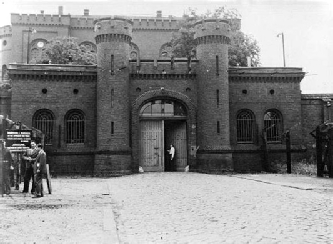
Some of the close (political) friends of Adolf Hitler were kept in prison here after the war. Their names: Rudolf Hess, Albert Speer, Baldur von Schirach, Walther Funk, Erich Raeder, Constantin von Neurath and Karl Dönitz.
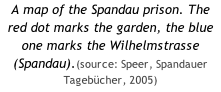
Albert Speer gardening at
Spandau Prison
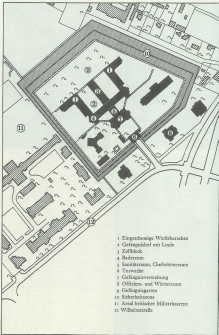
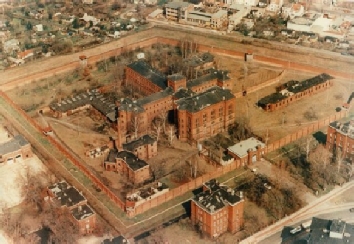
A map of the Spandau prison. The red dot marks the garden, the blue one marks the Wilhelmstrasse (Spandau). Download and enlarge the picture
to read the text and placemarks
below it
City Train Station Heerstrasse (10)
Location: Heerstrasse, near Olympic Stadium and Theodor Heuss Platz
Today: Not sure about the preservation of the station
Hitler welcomed Mussolini here, when he visited Berlin in 1937.
HOME
HISTORIC HITLER SITES

Sportforum (9)

Location: In the Hans-Braun-Strasse, near the Olympic Stadium, once was something called the German Sport Forum

Today: This is the location where the Sportmuseum Berlin is today.

Hitler held a speech at the Sportforum on July 27, 1932.

Berlin

Berlin West and Berlin South

Berlin West

What’s called Berlin West here is the area west of the road 100, the Messedamm and the Hohezollerndamm.    

1.Wannsee villa

2. Planned villa Albert Speer

3. Goebbels Schwanenwerder villa

4. Villa Dr. Morell

5. Albert Speers rented villa

6. Planned villa Adolf Hitler

7. Spandau Prison

8. Olympic Stadium

9. Sportforum

10. Station Heerstrasse

11. Gaststätte Neue Welt (?)

12. Theodor-Heus-Platz

13. Messegelände Automobilausstellung

14. Deutschalndhalle

15. Bahnhof Finkenkrug

16. Siemensdamm

17. Harriesstraße


Berlin West weergeven op een grotere kaart
Bahnhof Berlin-Finkenkrug (14)
Location: Karl-Marx-Straße
Today: There’s a station at this location. Not sure about its origin.
Hitler and his people left the station Berlin-Finkenkrug on May  9, 1940 at 16.38 hours in the Sonderzug Amerika. The train was heading to Euskirchen, near the Felsennest in Rodert. A lot of people inside the train didn’t know where they were going because the attack on France, Belgium, the Netherlands and Luxembourg was kept a secret. The train went through Hamburg and Hannover to get to Euskirchen.
Deutschlandhalle (15)
Location: Corner Jafféstrasse and Messedamm
Today: Destroyed, new hall primarily used for ice hockey.
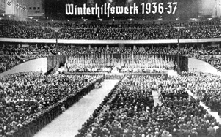
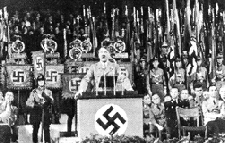
Hitler opened the Deutschlandhalle in 1935. For the occasion he held a speech there. The uge building was destroyed by British bombs in 1943 but it was rebuilt in 1957. On March 24, 1936 Hitler spoke at the Deutschlandhalle. The openings of the Winterhilfswerk 1936/37 and 1937/38 also took place at the Deutschlandhalle. Hitler held a speech.
Left: The Deutschlandhalle in 1936, Right: Hitler speaks at the Deutschlandhalle

Hitler thanks the work force for building the new Reichskanzlei, December 23, 1938
Siemens-Werke (16-17)

Location: Siemensstadt, between Spandau and Charlottenburg

Today: Gone. The road name Siemensdamm and the name Siemenstadt is stil  remind  of Siemensstadt. There was a so called Werksiedlung (streets where the workers lived) in and around the Harriesstrasse.

On November 10, 1933 Hitler spoke to the workers of the Siemens-factory in Berlin.


Practice Theo Morell 1919 - 1935 (32)
Location: Bayreutherstrasse 7
Today: Gone. It seems that modern buildings are on this location now.
Theo Morell was Hitlers favourite doctor. He had his first practice here. I’ve found no proof that Hitler was ever here.
Practice Theo Morell 1935 - 1945 (33)
Location: Kurfürstendamm 216
Today: Still there.
Theo Morell replaced  his old practice for a better one on the Kurfürstendamm in 1935, but Morell travelled a lot, because Hitler wanted him around when he was not in Berlin.

Morells practice on the Kurfürstendamm.

(picture: Michel Groot, go2war2.nl)