Nürnberg
Nürnberg is a place of great importance for both sides in World War 2. For the Nazis it was the city  of the Nazi Party, for the Allied Powers it was the place of the trials against the German warcriminals. On this website you’ll find information about the Parteitagsgelände and the Allied Military Tribunal. There is a lot more to see in Nürnberg. There’s some architecture typical for the Nazi-period, there are some places in the city wellknown because of the pictures of Hitler, there are a lot of bunkers etc. Because there already is a great website with all the important places and exact addresses, we don’t mention everything. We stick to the Hitler-related ones and we won’t mention everything that is war related. We highly recommend the website about Nürnberg, mentioned at the end of this page.  
Parteitagsgelände
Not in every place in Germany with an important place in nazi history there is as much information being given as in Nürnberg on the Parteitagsgelände. The Kongresshalle is now an information centre and all around the Gelände are good informationstands. There was a lot more planned than carried out in this area. The large Deutsche Stadion and some other smaller buildings were never built. The Märzfeld and the Kongresshalle (on both sides of the Grosse Strasse) were never finished. The area is known best for the Parteitage after the NSDAP got in charge of Germany, but Hitler already spoke at the Luipoldhain in 1927.
Grosse Strasse
With the Zeppelintribune in your back, you walk around the field on the right side (Herman Böhm Strasse), when you keep on walking straight ahead, you’ll get to the Grosse Strasse
Today: still there
The Grosse Strasse links the Volksfestplatz behind the Kongresshalle to the Märzfeld.
Grandstand on the side of the Grosse Strasse. View in direction of the Märzfeld-area
Steps of the grandstand
Grosse Strasse. View in direction of the Volksfestplatz behind the Kongresshalle
Zeppelinfeld/Zeppelintribüne
Zeppelinstrasse/Beuthenerstrasse
Today: still there
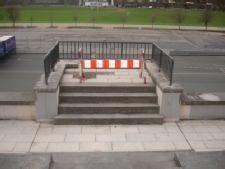
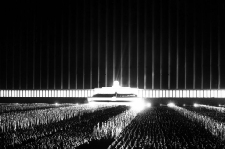
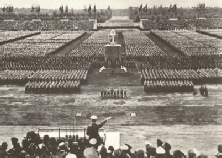
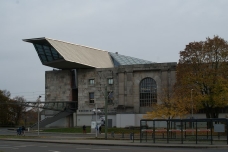
The Zeppelintribüne is a very wellknown nazi-symbol. The field was used for Parteitag demonstrations. There’s a speaker’s platform were Hitler held his speaches. The platform was highered in the past. There are steps inside it now. On old pictures there is no fence on the wall around it. The inside of the tribune has been open for the public in the past, but it is closed today. The architect was Albert Speer. The tribune and the field are yet another perfect example of nazi-architecture. Complete symetrical buildings with white/yellow rectangled stone-facades and a touch of roman empire. The roads around the tribune are now being used for car races.
The Zeppelintribune
The Zeppelintribune with the speaker’s platform in the centre
The tribune on the right side of the building
The door behind the speaker’s platform
The door on the left side of the building
The speaker’s platform. A symbolic picture...
Three picture of the little buildings/stands around the field
The Zeppelinfield
The back of the tribune
Doors in the back of the tribune
Left: The Zeppelintribune
Middle: The inside
Right: The tribune by night
Kongresshalle
Bayern Strasse
Today: Documentation Centre (Bayernstrasse 110), never finished
The Kongresshalle was designed by Franz and Ludwig Ruff. They were obviously inspired by the Coloseum in Rome. It was ment to have a roof, but the building wasn’t finished. It’s the second largest Third Reich building. The largest is a vacation hotel on the island Rügen. For information about Rügen, go to: www.ruegen-kompass.de or www.proradok.de.
The Kongresshalle. The first two pictures were taken from the path between the Zeppelinfield and the Grosse Strasse, behind the dried up ‘lake’ Grosse Dutzendeich, the last one from up the roof of the Ehrenhalle
Luitpold Arena
Bayern Strasse, across the road from the Kongresshalle
Today: Park;  Only the shape of the arena, some steps and the Ehrenhalle (wich was already there in 1929) and of course the good information stands remind of the Third Reich period
In the Luipold Arena the SA and SS used to gather. The arena could hold about 150.000 people.  The Luitpoldhalle hasn’t survived the bombings in World War II. The ruïns of it have been removed after the war. The Ehrenhalle is a memorial for the fallen in World War I. In November 2006 there was a stage put up against the Ehrenhalle wich made it possible to take some pictures from up above the roof.  
The Luitpold Arena seen from the roof of the Ehrenhalle
The steps of the arena that
remain today
Another view of the arena. You can see the round shape of it here
The Ehrenhalle in plastic
Information stand near the Ehrenhalle. Hitler is in the centre of the picture
The Ehrenhalle is a memorial for WW
The same view as the picture with Hitler on it, today
The spot were Hitler stood. The actual stones were he stood on are no longer there
At ground level
Inside the Ehrenhalle
The Ehrenhalle
Behind the Ehrenhalle is another monument: for WW I and WW II
Allied Military Tribunal used for the Nürenberg Trials
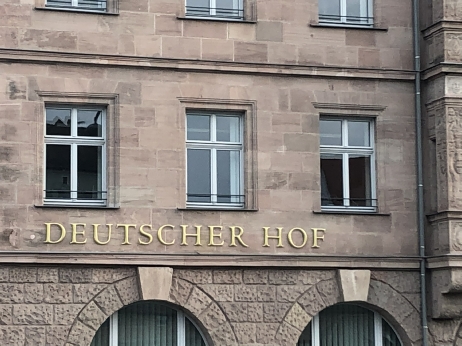
Hotel Deutscher Hof today
Speech at the Rosenausaal
Location: unknown
On August 1, 1920 Hitler held a speech in the Rosenausaal.
Braunes Haus/ Hitler Haus/ NSDAP Gauhaus
Location: Marienplatz 5
Today: still there, restoredused by the press: the Nürnberger Nachrichten
Left: Hitler at the construction site of the Braunes Haus
Above: The building after it was ruined at the end of the war
Zentralsälen - Kolosseum
Location: unknown
On January 3, 1923 Hitler held a speech in the Zentralsälen. In that same year he held four other speeches there. In 1925 (after his time in the Landsberg jail) he spoke here again. It seems that they were part of a building called the Kolosseum, but I’m not entirely sure about that. It is mentioned that Hitler spoke at the Kolosseum on different dates, for instance in May 1927 and in May and November 1928. On July 24, 1930 Hitler also spoke at the Kolosseum.
Festhalle
Location: unknown
On September 2, 1923 Hitler was in Nürnberg for the Deutschen Tages. He spoke at the Festhalle.
The inside of the Festhalle
The Kulturverein in Nürnberg
Kulturverein - Kulturvereinshaus
Location: Frauentorgraben 49
Today: On the second of January 1945 the building was destroyed. In 1967 the last remains of the building were taken away.
On September 2, 1923 Hitler held a speech on the occasion of the Deutschen Tages in the Kulturverein. It’s the same building where the Reichstag gathered the Nürnberg racial laws were made official. On August 21, 1927 and August 4, 1929 Hitler also spoke at the Kultursvereinshaus.
Herkulessaal/ Herkulessaalbau
Location: unknown
Hitler  held speeches at the Herkulessaal in Nürnberg, for instance on December 4, 1925 and on August 1 and December 8, 1926, March 23 and June 9, 1927 and March 22, 1929.
Leonhardspark
Location: Webersgasse, Michael-Ende-Strasse, Leonhardsplatz
Today: a new  neighbourhood is arising at the location (2008)
Hitler held a speech in this park on March 2, 1925. He held two other speeches in Nürnberg on that day: one in the Bäckerherberge and one in the Zentralsälen.
Bäckerherberge
Location: unknown
Hitler held a speech at the Bäckerherberge on March 2, 1925.
The city of Nürnberg
Lehrerheim
Location: Frauentorgraben 29
Today: unknown
Hitler held a speech at the Lehrerheim on December 3, 1928.
Wiesenterrasse
Location: unkown
Hitler held a speech at the Wiesenterrasse on August 4, 1929, on occasion of the Reichsparteitages.  
Go to the good websiteswww.bauzeugen.de or www.thirdreichruins.com to learn a lot more about Nürnberg.
MüNCHEN.BERLIN.OBERSALZBERG.BERCHTESGADEN AND REGION.OTHER PLACES IN GERMANY.
HOME.TIMETABLE.GERMANY.AUSTRIA.POLAND.BELGIUM & FRANCE.ITALY.CZECHOSLOVAKIA.UKRAINE.OTHER COUNTRIES.E-MAIL.
HOME
HISTORIC HITLER SITES

Luitpoldhalle - Alte Kongreshalle (Festhalle Luitpoldhain)

Location: Bayernstrasse, Luitpoldhain-side

Today: parking place and Sealife

In 1906 there was a congress about industrie and art on the Luitpoldhain. The buildings that were made, were taken down again, exept the Maschinenhalle. It was renovated and called Luitpoldhalle (or Alte Kongresshalle)

Hitler already spoke at the Luitpoldarea in 1927. In 1932, on March 7, April 6 and October 13, he spoke (each time to about 30.000 people) at the Alte Kongreshalle. The facade of the Luitpoldhalle was changed in nazi-times.   

The Luitpoldhalle before the makeover

(source:www.german-architecture.info)

The Luitpoldhalle after the makeover


Hitler, Hess and in the background Goebbels inside the Luitpoldhalle

(source: einestages.spiegel.de)


Franken-Stadion

Location: Max-Morlock-Platz 1, near the Zeppelinfield

Today: Easycredit-Stadion

On July 30, 1932 Hitler spoke at the Stadion of Nürnberg.


The stadium today. In the background is the Zeppelinfield and tribune

Military Tribunal
Fürther Strasse 110 (U-bahn stop Barenschanze), room 600, in the building on the right, a little further from the road than the main building
Today: still there, the room were the nazi-criminals were put to trial has changed, but it still has the same atmosphere; the room is still in use as a courtroom
Some of the close (political) friends of Hitler were put to justice in Nürnberg, like Albert Speer, Rudolf Hess and Hermann Göring. They were kept in the jail behind the Palace of Justice.
In November 2006 the building of the Nürnberg Trials (a part of the Palace of Justice) was being  renovated. We were able to take a look inside to see that the room itself hasn’t been changed more than it already had.  
The part of the Palace of Justice with room 600
© the Hitler Pages
The four big windows in the centre are the windows of room 600
© the Hitler Pages
The windows
© the Hitler Pages
A memorial of the tribunal inside the building
© the Hitler Pages
The grand courtroom door
© the Hitler Pages
Two smaller doors leading into the courtroom
© the Hitler Pages
There’s a picture on the wall in the hall of how the courtroom used to be
© the Hitler Pages
The courtroom in November 2006
© the Hitler Pages
The other side of the courtroom
© the Hitler Pages
The prison behind the Palace of Justice © the Hitler Pages
Göring in his cell in Nürnberg

Rathaus

Location: Rathausplatz 2, east of the Sebalduskirche

Today: still there, large parts were destroyed in 1945, but the buildings restored

On August 30, 1933 Hitler spoke at the Rathaus of Nürnberg.


Trauerede Philipp Michael Schuhmacher

Location: unknown

On November 27, 1933 Hitler held a Trauerede for Philipp Michael Schuhmacher of the Infanterieregiment 21.


The Rathaus of Nürneberg in 2007

(picture: www.wikipedia.de)